Technology
UV-C air purification engineered for real buildings.
SterileSpace systems apply controlled UV-C treatment, airflow-aware placement, and application-specific design to support cleaner indoor air across healthcare, education, commercial, residential, modular, and specialty environments.
UV-C Treatment
Designed to help reduce airborne biological contaminants as air passes through controlled treatment zones.
Airflow Integration
Configured around duct paths, room conditions, occupancy patterns, and installation constraints.
Continuous Support
Built for ongoing indoor air quality support in spaces where clean air matters every day.
How it works
Air treatment starts with movement, exposure, and fit.
UV-C air purification is most effective when the treatment pathway is designed around how air actually moves. SterileSpace applies UV-C energy inside controlled treatment zones, helping reduce airborne biological contaminants as air passes through the system.
01
Air enters the pathway
Air is drawn into a room-based unit or directed through an HVAC pathway, depending on the space and installation strategy.
02
UV-C exposure occurs
Inside a controlled treatment zone, UV-C energy targets airborne microorganisms as they move through the system.
03
Treated air returns
Air returns to the room, duct system, or occupied environment as part of continuous indoor air-quality support.
Exposure model
Cleaner air performance depends on more than the lamp.
Professional UV-C design balances three factors: UV-C intensity, exposure time, and airflow path. The right system is not simply brighter; it is better matched to the space, the equipment, and the way air is captured and returned.
Airflow-aware design
Engineered for the way buildings actually breathe.
Room size, ceiling height, occupancy, ventilation, installation access, and daily use all affect system selection. A clinic, classroom, salon, gym, home, and workforce camp should not all use the same approach.
01
Review the space
Room volume, occupancy, ceiling height, and daily use shape the right air-treatment approach.
02
Map the airflow path
Returns, ducts, doors, pressure zones, and occupied areas influence where treatment should happen.
03
Match the system family
In-duct, room-based, and specialized systems are selected around the building and installation context.
Technology principles
What UV-C supports, and what it does not replace.
SterileSpace is part of a broader indoor environmental quality strategy, not a substitute for good building practice.
Helps reduce airborne biological contaminants
UV-C exposure can help inactivate or reduce airborne microorganisms in controlled air treatment contexts.
Supports cleaner shared environments
Designed to support ongoing air-quality strategies in occupied rooms, HVAC pathways, and specialty spaces.
Works with broader IAQ planning
Ventilation, filtration, HVAC maintenance, cleaning protocols, and moisture control still matter.
System architecture
Different spaces need different pathways.
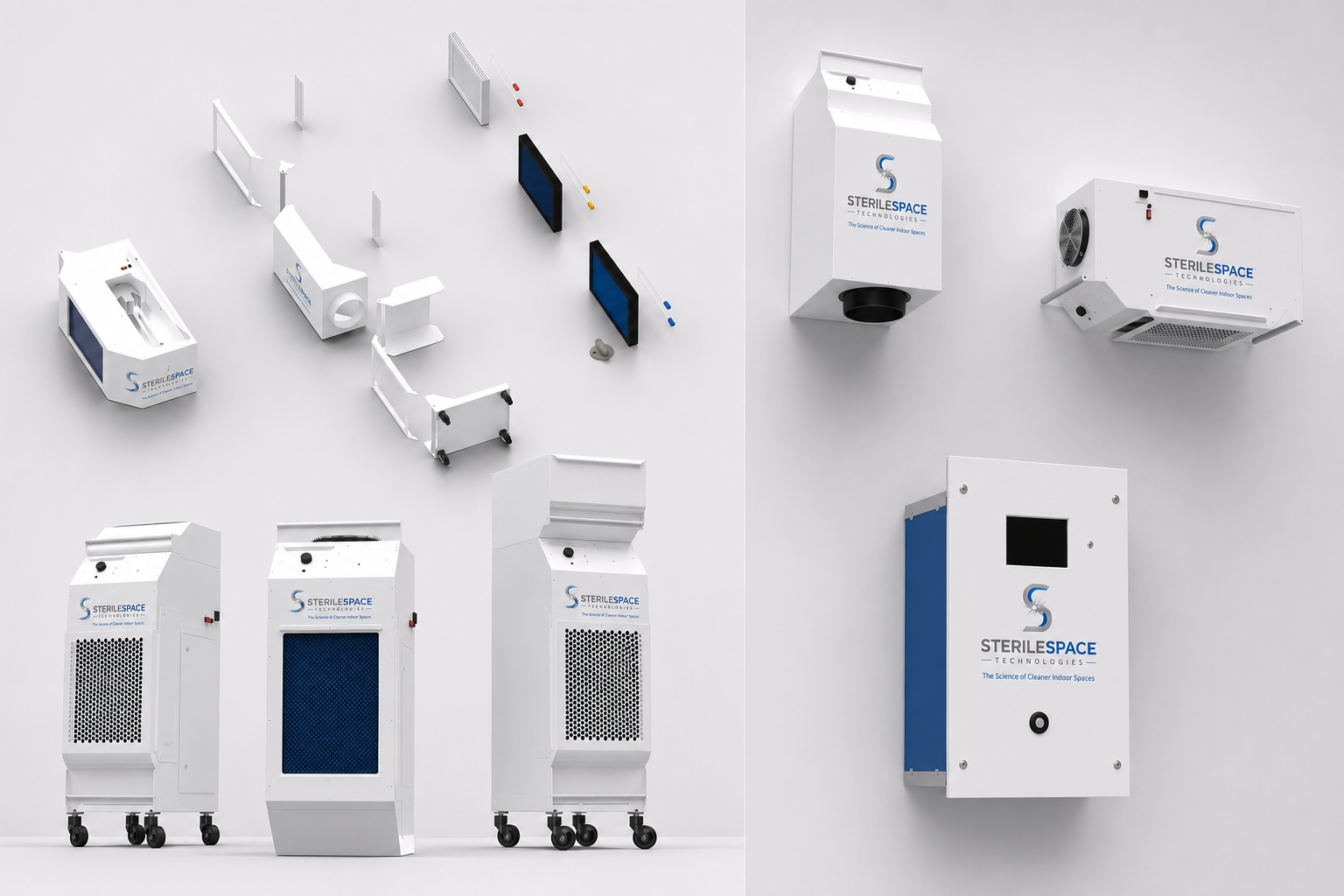
In-duct systems
For HVAC-connected air movement strategies where duct access and configuration allow.
Room-based systems
For occupied rooms, shared spaces, clinics, classrooms, salons, offices, and homes.
Specialized applications
For modular, industrial, agricultural, mobile, and constrained environments.
Assessment pathway
Match the technology to the space.
Tell us about the building, air-quality concerns, and installation context. SterileSpace can help identify the right system pathway.